Buffalo Bills vs Los Angeles Rams Match Player Stats: A Detailed Breakdown of an Offensive Classic

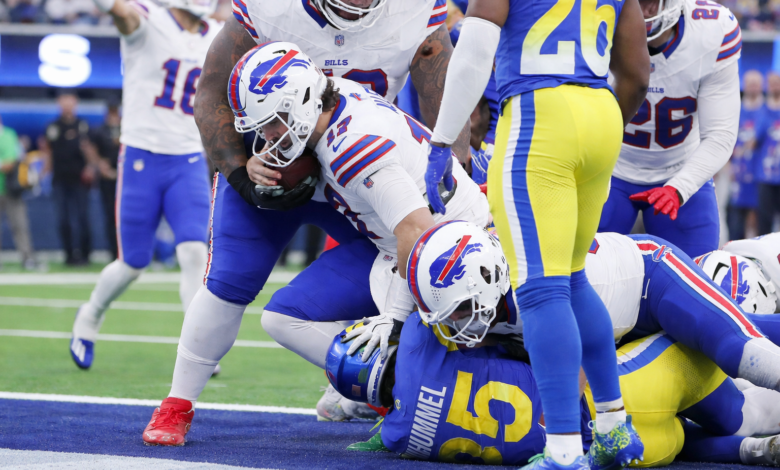
The Buffalo Bills vs Los Angeles Rams Match Player Stats from this dramatic encounter tell the story of one of the most entertaining and statistically rich games of the NFL season. It was a matchup defined by elite quarterback play, relentless offensive execution, and a narrow margin that came down to possession control and finishing ability. While the final score showed just a two-point difference, the underlying player stats reveal how the Rams managed to edge the Bills despite Buffalo producing one of its most explosive offensive performances of the year.
From the opening drive, both teams made it clear that this would not be a conservative contest. The Bills struck quickly and repeatedly through the arm and legs of Josh Allen, while the Rams answered with long, methodical drives built around precision passing and a powerful rushing attack. The statistical output on both sides was immense, yet the distribution and timing of that production ultimately shaped the result.
Game flow and statistical landscape
Understanding the Buffalo Bills vs Los Angeles Rams Match Player Stats begins with the rhythm of the game. Buffalo scored fast and often, generating points in bursts that kept constant pressure on the Rams. Los Angeles, by contrast, focused on controlling tempo, sustaining drives, and limiting the number of possessions available to Buffalo’s offense. This contrast explains why both teams accumulated similar yardage totals, yet the Rams were able to dictate the pace for much of the game.
The Rams’ extended time of possession allowed their offensive players to compile steady, repeatable production. Buffalo’s stats, while equally impressive, were condensed into fewer offensive series, forcing the Bills to be near-perfect when they had the ball. This dynamic is critical to interpreting individual performances correctly, as raw numbers alone do not capture the context in which they were produced.
Josh Allen’s all-around dominance
At the center of the Buffalo Bills vs Los Angeles Rams Match Player Stats is Josh Allen’s extraordinary performance. As a passer, Allen delivered over 340 yards through the air with three touchdown throws, consistently attacking downfield and stretching the Rams’ secondary. His passing was aggressive but controlled, as he avoided interceptions while still taking calculated risks that led to explosive gains.
What elevated Allen’s performance from excellent to historic was his rushing impact. He led the Bills in rushing yards and scored three additional touchdowns on the ground, repeatedly overpowering defenders in short-yardage and red-zone situations. These quarterback runs were not improvisational scrambles but deliberate, designed plays that exploited defensive spacing and hesitation. Each rushing touchdown reflected Buffalo’s confidence in Allen as both a physical runner and a decision-maker under pressure.
Allen’s statistical line illustrates how Buffalo’s offense is built around versatility. When the Rams tightened coverage or disrupted passing lanes, Allen’s mobility ensured the offense never stalled completely. His dual-threat output accounted for the majority of Buffalo’s scoring, underscoring his central role in the team’s offensive identity.
Buffalo’s receiving production and offensive balance
Beyond Allen, the Buffalo Bills vs Los Angeles Rams Match Player Stats show a receiving corps that contributed in complementary ways. Khalil Shakir emerged as the most productive receiver in terms of yardage, surpassing the century mark and adding a touchdown. His ability to find space in intermediate zones and turn catches into chunk gains gave Buffalo a consistent source of explosive plays.
Amari Cooper played a different but equally important role. He commanded the highest number of targets, serving as the primary option on critical downs. While his stat line did not include a touchdown, his yardage total and target volume reflect his importance in maintaining offensive structure and drawing defensive attention.
Other receivers and backs contributed timely scores, reinforcing the idea that Buffalo’s passing attack was not dependent on a single outlet. This distribution of production made the Bills difficult to defend and allowed them to score quickly when opportunities arose, a key factor in keeping the game close despite fewer total possessions.
Matthew Stafford’s efficiency-driven performance
On the Rams’ side, the Buffalo Bills vs Los Angeles Rams Match Player Stats highlight Matthew Stafford’s efficiency as the foundation of Los Angeles’ success. Stafford completed a high percentage of his passes, surpassing 300 yards and throwing two touchdowns without turning the ball over. His performance was defined less by spectacular individual plays and more by consistency and timing.
Stafford repeatedly delivered the ball on schedule, enabling receivers to gain yards after the catch and keeping the offense ahead of the chains. This efficiency allowed the Rams to convert third downs, extend drives, and maintain control of the clock. While Buffalo’s offense often scored quickly, Stafford’s approach ensured the Rams could respond with long possessions that limited Buffalo’s opportunities to strike again.
The absence of interceptions in Stafford’s stat line is especially significant in such a high-scoring game. By protecting the football, he ensured that every Rams drive ended with a kick, either a punt, a field goal, or most often, a touchdown. That discipline was a decisive factor in a game where momentum swings could have been catastrophic.
Kyren Williams and the Rams’ rushing identity
The Rams’ rushing stats add another layer to the Buffalo Bills vs Los Angeles Rams Match Player Stats narrative. Kyren Williams handled an exceptionally heavy workload, carrying the ball nearly thirty times and scoring twice. While his average yards per carry were modest, the cumulative effect of his runs was substantial.
Williams’ repeated carries wore down the Bills’ defense and allowed the Rams to control tempo. Each successful run shortened the game, limited Buffalo’s offensive chances, and created favorable down-and-distance situations for Stafford. This approach exemplifies how rushing production can be valuable even without gaudy per-carry averages.
The Rams also used creative rushing concepts involving other skill players, including a rushing touchdown from a wide receiver. These plays forced Buffalo to defend the entire width of the field and added unpredictability to the Rams’ offensive profile. Together, these rushing stats illustrate a commitment to balance that complemented the passing game perfectly.
Puka Nacua and the Rams’ receiving dominance
No discussion of the Buffalo Bills vs Los Angeles Rams Match Player Stats is complete without focusing on Puka Nacua’s standout performance. Nacua recorded double-digit receptions and amassed well over 150 receiving yards, establishing himself as the most influential receiver on the field. His ability to win consistently against coverage, both inside and outside, gave Stafford a reliable target on virtually every drive.
Nacua’s production was not limited to one or two explosive plays. Instead, it was built through repeated success on intermediate routes, where he demonstrated strong hands, precise route running, and toughness after the catch. His touchdown came at a critical moment, halting a Buffalo surge and restoring the Rams’ lead when the game threatened to swing.
Cooper Kupp complemented Nacua with a high-impact performance of his own, contributing significant yardage and a touchdown. The pairing of Nacua and Kupp created constant matchup problems, forcing Buffalo to make difficult coverage decisions that often resulted in favorable looks for the Rams.
Defensive workload and statistical implications
Defensive stats in a shootout can be misleading, and the Buffalo Bills vs Los Angeles Rams Match Player Stats reflect this reality. Buffalo defenders recorded high tackle totals, particularly in the secondary and linebacker positions. These numbers indicate effort and involvement but also highlight how often the Bills’ defense was on the field.
The Rams’ extended drives required Buffalo defenders to make tackle after tackle, gradually wearing them down over the course of the game. While the Bills did not commit major coverage breakdowns, the sheer volume of snaps limited their ability to generate momentum-shifting plays such as turnovers or negative-yardage stops.
For the Rams, defensive success was measured less by individual stats and more by situational effectiveness. By forcing Buffalo to operate in fewer possessions and respond under constant time pressure, the Rams’ defense indirectly shaped the statistical environment in which Buffalo’s players operated.
Special teams and hidden statistical edges
Special teams played a subtle but meaningful role in the Buffalo Bills vs Los Angeles Rams Match Player Stats. A blocked punt returned for a touchdown provided the Rams with a crucial scoring boost that altered game script. That single play effectively increased the scoring margin Buffalo needed to overcome and forced the Bills to remain aggressive throughout the second half.
Kicking efficiency on both sides was largely steady, ensuring that special teams did not introduce volatility late in the game. However, the Rams’ ability to capitalize on a rare special teams breakdown contributed directly to their narrow victory and is an essential part of understanding how the final score came to be.
Interpreting the stats beyond the scoreboard
When viewed in isolation, the Buffalo Bills vs Los Angeles Rams Match Player Stats suggest two offenses operating at peak efficiency. Buffalo generated explosive scoring through its quarterback, while Los Angeles built sustained success through balance and control. The key difference lies in how and when those stats accumulated.
Buffalo’s production was concentrated and urgent, reflecting an offense capable of scoring quickly but limited by possession count. The Rams’ production was expansive and methodical, reflecting an offense designed to maximize each drive and minimize risk. In a game decided by two points, that philosophical difference proved decisive.
Conclusion
The Buffalo Bills vs Los Angeles Rams Match Player Stats capture a game that will be remembered for its offensive brilliance and razor-thin margin. Josh Allen delivered one of the most remarkable dual-threat performances of the season, accounting for six total touchdowns and keeping Buffalo within reach until the final moments. The Bills’ receiving corps supported him with explosive plays and balanced production, demonstrating the versatility of Buffalo’s offense.
Yet the Rams prevailed by executing a complementary game plan built around Matthew Stafford’s efficiency, Kyren Williams’ relentless rushing volume, and a dominant receiving performance from Puka Nacua. By controlling possession, protecting the football, and answering Buffalo’s scoring surges with composure, Los Angeles created just enough separation to secure the win.
Ultimately, these match player stats show that in high-scoring games, opportunity and control can matter as much as raw production. The Rams turned their statistical advantages into a victory, while the Bills were left with an extraordinary offensive showing that fell just short.
FAQs
Who was the top performer in the Buffalo Bills vs Los Angeles Rams match
Josh Allen stood out with a rare dual-threat performance, producing multiple passing and rushing touchdowns.
Which Rams player had the biggest statistical impact
Puka Nacua led the Rams with dominant receiving yardage and a key touchdown that shifted momentum.
Why did the Rams win despite similar total yards
Los Angeles controlled time of possession and sustained longer drives, limiting Buffalo’s opportunities.
How important was the rushing game in this match
Rushing was critical, with Josh Allen scoring on the ground for Buffalo and Kyren Williams controlling tempo for the Rams.
What decided the game in the end
Efficiency, possession control, and timely scoring allowed the Rams to edge the Bills in a close finish.


