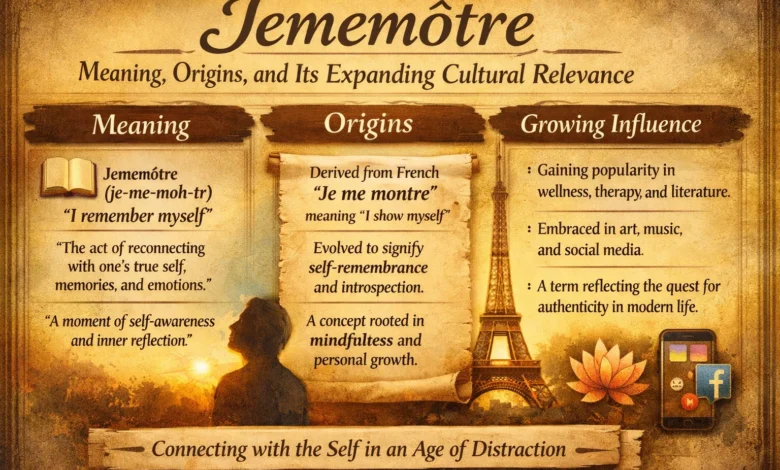
The word jememôtre carries an unusual visual form and an even more intriguing conceptual weight. At first glance, it looks unfamiliar, almost fragmented, yet it resonates with the way modern language evolves across cultures, technologies, and personal expression. Words like this do not emerge randomly; they grow from intersections of language, emotion, and shared human experience. In that sense, jememôtre is less about strict definition and more about meaning shaped by context.
In recent years, jememôtre has gained attention in digital spaces where identity, memory, and expression blur together. It appears in conversations that explore self-awareness, reflection, and emotional nuance. Rather than being confined to a dictionary-style explanation, the term lives through interpretation, storytelling, and usage. That flexibility is exactly why it continues to attract curiosity and discussion.
Linguistic Roots and Evolving Interpretations
Language is constantly in motion, and jememôtre reflects that reality clearly. The structure of the word hints at Romance language influences, particularly French-inspired phrasing, where emotion and self-reference are often woven together. The visual accenting and construction suggest a layered meaning rather than a single literal translation.
Over time, users have adopted jememôtre as a symbolic expression rather than a grammatical one. It may evoke ideas of self-remembrance, emotional awareness, or internal acknowledgment. Linguists often note that when words break traditional spelling or structure, they usually emerge from creative or digital subcultures. Jememôtre fits neatly into that pattern, carrying emotional resonance without being locked into rigid rules.
jememôtre in Digital Communication
Online spaces have played a huge role in shaping how jememôtre is understood today. Social platforms encourage compressed expression, and people often gravitate toward words that feel personal yet open-ended. Jememôtre thrives in this environment because it feels intimate without being overly specific.
In forums, captions, and reflective posts, the term is often used to signal self-connection or emotional grounding. It can appear as a quiet statement rather than a declaration, offering space for interpretation. One writer described it beautifully: “Some words don’t explain you to others; they explain you to yourself.” That idea aligns closely with how jememôtre is used in digital storytelling.
Cultural Symbolism and Emotional Weight
Culture shapes language just as much as language shapes culture. Jememôtre has gradually taken on symbolic meaning related to self-identity and emotional honesty. In creative writing and visual art discussions, it often appears as a marker of introspection or personal truth.
This emotional weight is not accidental. Modern culture places strong emphasis on self-awareness, mental health, and authenticity. Words that suggest inward reflection naturally gain traction. Jememôtre becomes a linguistic mirror, reflecting internal states rather than external actions. That symbolic role gives it lasting relevance beyond trends.
The Role of Memory and Self-Identity
At its core, jememôtre is frequently associated with memory and identity. Whether intentional or not, its structure hints at remembrance and self-reference. In essays and reflective pieces, it is sometimes used to describe moments of self-recognition or emotional clarity.
Psychologists often emphasize the importance of naming internal experiences. When people lack words, emotions feel chaotic. Jememôtre functions as a placeholder for complex feelings that are difficult to articulate. As one cultural commentator noted, “A word doesn’t need a perfect definition if it perfectly captures a feeling.” This perspective helps explain why the term continues to circulate.
Artistic and Creative Usage
Artists and writers are often the first to adopt unconventional language. Jememôtre appears in poetry, digital art captions, and experimental prose where ambiguity is a strength. Rather than explaining everything, it invites the reader to feel.
In creative contexts, the word often symbolizes pause and awareness. It marks a moment where the creator turns inward. This usage reinforces its association with authenticity and self-expression. Over time, these artistic interpretations influence broader cultural understanding, giving jememôtre a richer emotional palette.
Comparison With Similar Abstract Terms
To better understand jememôtre, it helps to compare it with other abstract expressions used for self-reflection and identity. While many terms attempt to define emotional states, few maintain the same openness.
| Conceptual Term | Core Theme | Typical Usage Context |
|---|---|---|
| jememôtre | Self-awareness and remembrance | Creative writing, digital reflection |
| Mindfulness | Present-moment awareness | Psychology, wellness |
| Introspection | Internal examination | Academic and therapeutic settings |
| Authenticity | Being true to oneself | Personal branding, culture |
What sets jememôtre apart is its lack of institutional framing. It does not belong to psychology textbooks or corporate language. Instead, it remains fluid, shaped by those who use it.
Relationship Advice FPMomHacks: A Real-Life Guide to Stronger, Healthier Connections
Social Identity and Personal Branding
In the age of personal branding, words carry social signals. Jememôtre is sometimes used subtly in bios or creative profiles to suggest depth and introspection. It communicates values without direct explanation.
This kind of signaling is common in online identity construction. People choose language that reflects how they see themselves or wish to be seen. Jememôtre fits well into minimalist self-descriptions, acting as an emotional shorthand rather than a statement of facts.
Globalization and Cross-Cultural Appeal
One reason jememôtre resonates widely is its cross-cultural feel. It does not belong clearly to one language or region, which allows people from different backgrounds to project their own meanings onto it.
Global digital culture thrives on this kind of ambiguity. When a term is not tied to strict cultural rules, it becomes more adaptable. Jememôtre’s visual uniqueness also makes it stand out, increasing memorability and shareability across platforms.
Psychological Perspectives on Naming Feelings
From a psychological standpoint, the popularity of jememôtre aligns with emotional labeling theory. This theory suggests that naming emotions helps regulate them. Even abstract or invented words can serve this function.
By using jememôtre, individuals may be acknowledging a state of inner awareness without dissecting it. That simplicity can be calming. As one therapist famously said, “You don’t need perfect words; you need honest ones.” The term supports that idea through its flexible meaning.
jememôtre and Modern Minimalism
Minimalism in language mirrors minimalism in lifestyle. Many people seek fewer but more meaningful words. Jememôtre fits this minimalist approach by encapsulating complex ideas in a single expression.
In writing, minimalism values implication over explanation. The term often appears alone or with minimal context, letting the reader fill in the gaps. This stylistic choice enhances its emotional impact and keeps it from becoming overdefined.
Misinterpretations and Common Confusions
Because jememôtre does not have a fixed definition, misunderstandings are natural. Some people assume it is a typographical error or encoding issue. Others attempt to translate it literally, missing its symbolic use.
These confusions highlight an important aspect of modern language: not all words are meant to be decoded analytically. Some are meant to be felt. Over time, exposure and contextual use help clarify intent more effectively than formal definition ever could.
The Role of Community in Meaning-Making
Words gain meaning through shared use. Jememôtre exists because communities continue to use and reinterpret it. Online groups, creative circles, and writers contribute to its evolving identity.
This collective meaning-making process keeps the term alive. Rather than freezing its definition, users allow it to adapt. That adaptability is a strength, ensuring relevance even as cultural conversations shift.
Ethical and Emotional Authenticity
Using emotionally charged language carries responsibility. Jememôtre is often associated with honesty and self-awareness, which means careless use can dilute its impact. In thoughtful contexts, however, it reinforces emotional authenticity.
Writers who use the term intentionally tend to do so sparingly. This restraint preserves its weight. When overused, abstract words lose power, but jememôtre has so far avoided that fate due to its niche and reflective nature.
Future Relevance in Language Evolution
Language historians note that many meaningful words begin at the margins. Jememôtre may remain niche, or it may evolve into a broader cultural symbol. Either outcome reflects how language adapts to emotional needs.
As digital communication continues to value brevity and depth simultaneously, words like this will remain important. They offer emotional efficiency, allowing people to express complex states quickly and authentically.
Practical Contexts Where the Term Appears
Although abstract, jememôtre is not confined to art alone. It appears in journals, reflective essays, and even wellness discussions where emotional grounding is emphasized. Its versatility allows it to move between personal and public spaces.
In each context, the term retains its core association with self-connection. That consistency helps anchor its meaning, even as interpretations vary.
The Balance Between Mystery and Meaning
Part of jememôtre’s appeal lies in its mystery. Over-defining it would remove that charm. Instead, its meaning lives in usage, tone, and context.
Writers often leave it unexplained, trusting readers to feel rather than analyze. This approach aligns with modern storytelling trends that value emotional resonance over explicit explanation.
Conclusion
Jememôtre stands as a compelling example of how language evolves to meet emotional and cultural needs. It resists rigid definition while offering deep resonance, making it uniquely suited to modern communication. Through digital culture, creative expression, and shared interpretation, it has become a symbol of self-awareness and reflection. Its strength lies not in clarity alone but in its ability to hold space for meaning, memory, and identity without forcing boundaries.
FAQs
What does jememôtre generally represent in modern usage?
Jememôtre is commonly used as a symbolic expression of self-awareness, reflection, and emotional acknowledgment rather than a literal, dictionary-defined word.
Is jememôtre tied to a specific language or culture?
While it visually resembles Romance language structures, jememôtre is not confined to one culture and is widely adopted in global digital communities.
Why do writers and artists use jememôtre?
Creative individuals use jememôtre because its open-ended nature allows emotional expression without over-explanation, which suits reflective and artistic work.
Can jememôtre have different meanings for different people?
Yes, the meaning of jememôtre often depends on context and personal interpretation, which is part of its appeal and longevity.
Is jememôtre likely to remain relevant in the future?
Given its adaptability and emotional resonance, jememôtre is likely to continue appearing in reflective, creative, and digital communication spaces.