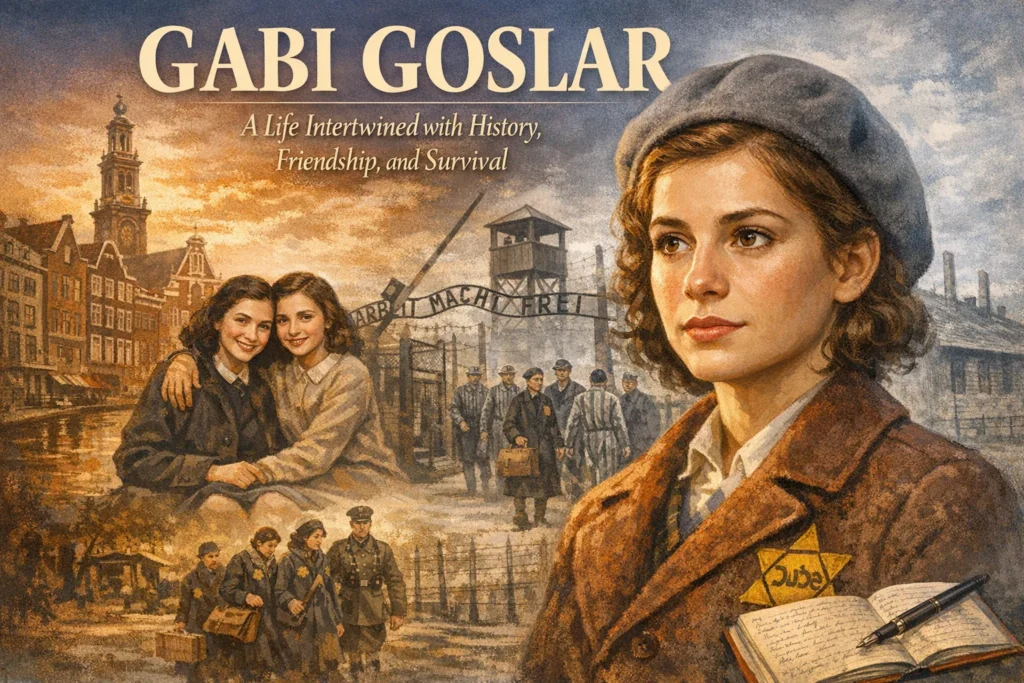

The story of gabi goslar is one that stands at the crossroads of friendship, tragedy, resilience, and remembrance. Her life is inseparable from one of the most widely read diaries in the world, yet her own experiences extend far beyond the pages that mention her name. While many people first learn about her through her childhood connection with Anne Frank, her journey deserves recognition in its own right. It is a powerful narrative of survival during the Holocaust, a testament to human strength under unimaginable conditions, and an enduring voice in the preservation of memory.
Born into a Jewish family in Germany and later forced to flee Nazi persecution, gabi goslar grew up in a world that shifted rapidly from normalcy to fear. Her life reflects the broader history of European Jews in the 1930s and 1940s—displacement, discrimination, and ultimately deportation. Yet within this dark chapter of history, her experiences offer moments of friendship, loyalty, and hope. Through her survival and later efforts to share her story, she became an important witness to history.
Understanding her life requires more than focusing on a single moment or relationship. It involves exploring her early years in Germany, her family’s escape to Amsterdam, the deep bond she formed with Anne Frank, the horrors of Bergen-Belsen concentration camp, and her postwar life dedicated to remembrance. Her journey is not just a historical account; it is a deeply human story that continues to resonate with new generations.
Early Life in Germany and the Shadow of Rising Nazism
Gabi Goslar was born in 1928 in Berlin, Germany, into a Jewish family that valued education, culture, and faith. Her father, Hans Goslar, was a prominent official in the German government during the Weimar Republic. The family lived a relatively comfortable and stable life before the rise of Adolf Hitler and the Nazi regime dramatically altered their world. As anti-Jewish laws intensified, everyday freedoms began to disappear.
The Nazi Party’s ascent to power in 1933 marked a turning point for Jewish families across Germany. The implementation of discriminatory legislation, including the Nuremberg Laws, stripped Jews of citizenship and basic rights. Jewish professionals were dismissed from their positions, businesses were boycotted, and children faced exclusion from schools. For the Goslar family, it became increasingly clear that remaining in Germany was not safe. Like many Jewish families who recognized the danger early, they sought refuge elsewhere.
Escape to Amsterdam and a New Beginning
In 1933, the Goslar family fled Germany and settled in Amsterdam, in the Netherlands. At the time, Amsterdam appeared to be a haven of tolerance and stability. Many Jewish refugees from Germany relocated there, believing they had found safety from Nazi persecution. Life began to regain a sense of normalcy. Gabi attended school, made friends, and adapted to a new culture and language.
It was in Amsterdam that she met Anne Frank. The two girls became close friends, sharing classrooms, secrets, and childhood adventures. They lived near each other and spent countless hours playing, talking, and dreaming about the future. Their friendship was built on innocence and trust, shaped by shared experiences as young Jewish girls navigating a foreign land.
The sense of security in Amsterdam, however, would not last. In May 1940, Nazi Germany invaded the Netherlands. The occupation brought with it the same systematic persecution that had already devastated Jewish communities in Germany. Gradually, restrictions tightened. Jews were required to register, wear yellow stars, and were barred from public spaces. The world that Gabi and her family had hoped would protect them began to collapse.
Friendship with Anne Frank and Shared Childhood Memories
The friendship between Gabi Goslar and Anne Frank remains one of the most poignant aspects of her life story. They attended the same Montessori school in Amsterdam and were inseparable during their early years there. They played games, celebrated birthdays, and navigated school life together. In many ways, their friendship represented the universal experiences of childhood—laughter, disagreements, dreams, and imagination.
Anne Frank later wrote about her friend in her diary, describing her as someone she trusted deeply. These references provide rare glimpses into Gabi’s personality during their youth. She was known to be thoughtful, somewhat serious, and loyal. Their bond reflected the close-knit nature of the Jewish refugee community in Amsterdam during that period.
When Anne and her family went into hiding in 1942, Gabi did not know where her friend had gone. Like many others, she believed that the Franks had fled the country. The sudden disappearance created confusion and sorrow. It was not until years later that she would understand the full story of the Secret Annex and Anne’s diary. At the time, all she knew was that her best friend was gone.
Deportation and the Journey to Bergen-Belsen
In June 1943, the Goslar family was arrested by the Nazis and deported. They were initially sent to the Westerbork transit camp in the Netherlands, a holding center for Jews awaiting transport to concentration camps in the east. Conditions were harsh, and fear was constant. Families were separated, and uncertainty loomed over every day.
Eventually, they were transported to the Bergen-Belsen concentration camp in Germany. Bergen-Belsen became notorious for overcrowding, disease, and starvation. Prisoners endured unimaginable suffering. Food was scarce, sanitation was minimal, and medical care was virtually nonexistent. Thousands perished from typhus and other illnesses.
It was in Bergen-Belsen that Gabi Goslar unexpectedly encountered Anne Frank again. The reunion occurred in early 1945, separated by barbed wire fences within the camp. Anne and her sister Margot were held in a different section. The two friends spoke through the fence, sharing brief moments of connection in the midst of horror. Gabi later recalled throwing food over the fence to help Anne survive. It was an act of compassion and courage during one of history’s darkest chapters.
Reunion in the Camp and Final Memories of Anne
The reunion at Bergen-Belsen remains one of the most emotional parts of Gabi’s testimony. She described seeing Anne weakened, thin, and ill. The vibrant girl she once knew had been transformed by hunger and disease. Despite the conditions, they managed to exchange words and memories. These encounters were short but deeply meaningful.
In interviews, she later reflected on those moments with a mix of sorrow and gratitude. “We spoke about the past,” she once said, recalling how they tried to hold on to memories of their childhood in Amsterdam. The barbed wire fence symbolized not only physical separation but also the brutal reality of their situation. Shortly after their reunion, Anne Frank succumbed to typhus in March 1945.
The loss profoundly affected Gabi. She survived Bergen-Belsen, but the memory of her friend’s death remained with her for the rest of her life. Liberation came in April 1945 when British forces entered the camp. Survivors emerged emaciated and traumatized, carrying stories that the world would struggle to comprehend.
Life After Liberation and Building a New Future
After the war, Gabi reunited with her father, who had survived Sachsenhausen concentration camp. Her mother and grandparents had been murdered. The family eventually immigrated to Palestine, which would later become the State of Israel. There, she built a new life, married, and raised children.
Adjusting to postwar life was not simple. Survivors faced physical and emotional scars that lingered long after liberation. Many struggled with grief, survivor’s guilt, and the challenge of starting over in a new land. Despite these hardships, she demonstrated resilience and determination. Her experiences shaped her worldview and commitment to remembering those who were lost.
She later became an important Holocaust educator, sharing her testimony with audiences around the world. Her perspective offered a unique lens—someone who knew Anne Frank personally and survived the same camp where Anne died. Through lectures, interviews, and documentaries, she ensured that the lessons of the Holocaust would not fade.
Historical Context and Key Milestones
The following table highlights major milestones in her life and their historical significance:
| Year | Event | Historical Context |
|---|---|---|
| 1928 | Birth in Berlin | Weimar Republic era in Germany |
| 1933 | Family flees to Amsterdam | Rise of Nazi regime under Adolf Hitler |
| 1940 | German invasion of Netherlands | Expansion of Nazi occupation across Europe |
| 1943 | Deportation to Westerbork | Intensification of Holocaust deportations |
| 1944 | Transfer to Bergen-Belsen | Severe overcrowding and disease in camps |
| 1945 | Liberation by British forces | End of World War II in Europe |
| Post-1945 | Immigration to Israel | Formation of Jewish homeland |
This timeline reflects not just personal events but the broader historical framework that shaped her life.
The Importance of Testimony and Holocaust Education
Holocaust survivors like Gabi Goslar became living witnesses to atrocities that must never be forgotten. Their testimonies provide firsthand accounts that counter denial and distortion. As the number of survivors diminishes with time, recorded interviews and written memoirs grow even more valuable.
Her story emphasizes the human dimension of history. Statistics alone cannot convey the depth of suffering endured during the Holocaust. Personal narratives bring faces and voices to historical events. By speaking publicly, she contributed to educational initiatives aimed at teaching younger generations about tolerance, human rights, and the dangers of antisemitism.
Educators often reference her experiences when discussing Anne Frank’s diary. While the diary captures life in hiding, Gabi’s testimony extends the narrative beyond the annex to the concentration camps. Together, these perspectives provide a fuller understanding of that era.
Cultural Legacy and Public Recognition
Over the years, documentaries, books, and exhibitions have featured her story. Institutions dedicated to Holocaust remembrance have invited her to speak, recognizing the unique historical value of her experiences. Her interviews often highlight themes of friendship, faith, and survival.
Her connection to Anne Frank continues to draw attention, but she has consistently emphasized her own journey as equally significant. She once remarked that people should remember not only the famous names but also the countless others whose stories were never written down. That sentiment underscores the collective memory of the Holocaust.
Public recognition has grown as interest in survivor testimonies increases. Museums and educational centers frequently include her recollections in their archives. Through these efforts, her voice remains accessible to future generations.
Jann Mardenborough Wife: The Truth About His Relationship, Love Life, and Private World
Reflections on Friendship, Memory, and Resilience
The life of gabi goslar illustrates how friendship can endure even in the face of unimaginable adversity. Her childhood bond with Anne Frank has become part of global history, yet it began as a simple school friendship between two girls adjusting to life in a new country. That innocence contrasts sharply with the brutality that followed.
Resilience defines her story. Surviving Bergen-Belsen required strength beyond measure. Rebuilding life afterward demanded courage and hope. Her commitment to remembrance transformed personal tragedy into a mission of education and awareness. “We must tell our stories,” she once said, emphasizing the responsibility of survivors to speak for those who could not.
Her journey encourages reflection on themes of human rights, tolerance, and moral responsibility. The lessons drawn from her experiences remain deeply relevant in modern society. Antisemitism, discrimination, and intolerance persist in various forms. Remembering the past helps safeguard the future.
Lasting Influence in Modern Discussions of the Holocaust
In contemporary discussions of Holocaust history, her testimony provides an essential complement to Anne Frank’s diary. While the diary ends before deportation, survivor accounts fill in the historical gap. Gabi Goslar’s recollections of Bergen-Belsen shed light on the final months of Anne’s life and the broader conditions within the camp.
Scholars, historians, and educators often cite her interviews to contextualize events described in the diary. Her perspective bridges personal memory and documented history. This combination strengthens the authenticity of Holocaust education and deepens public understanding.
Her legacy extends beyond historical documentation. It represents the triumph of memory over silence. By sharing her story, she ensured that future generations would learn not only about the horrors of genocide but also about the enduring strength of the human spirit.
Conclusion
The life story of gabi goslar is a profound testament to survival, friendship, and remembrance. From her early years in Berlin to her escape to Amsterdam, from her childhood bond with Anne Frank to the horrors of Bergen-Belsen, her journey reflects both personal resilience and historical significance. She endured persecution, loss, and unimaginable suffering, yet chose to dedicate her life to education and memory.
Her testimony enriches our understanding of the Holocaust, offering insight beyond the pages of Anne Frank’s diary. Through her voice, we gain a fuller picture of the era—one that includes both the innocence of childhood friendship and the brutality of concentration camps. Her commitment to sharing her experiences ensures that the lessons of history remain alive.
In remembering her story, we honor not only her resilience but also the countless victims whose voices were silenced. The enduring impact of her life serves as a reminder that history must be preserved, taught, and understood. Through remembrance, we affirm the values of dignity, compassion, and humanity.
FAQs
Who was gabi goslar?
Gabi Goslar was a German-born Jewish Holocaust survivor best known for her childhood friendship with Anne Frank. She survived Bergen-Belsen concentration camp and later became a Holocaust educator, sharing her testimony worldwide.
How did gabi goslar know Anne Frank?
She met Anne Frank in Amsterdam after both families fled Nazi Germany. They attended the same Montessori school and became close friends before the Frank family went into hiding in 1942.
Did gabi goslar see Anne Frank again after they were separated?
Yes, she encountered Anne Frank again in Bergen-Belsen concentration camp in early 1945. They spoke through a barbed wire fence, sharing memories and brief moments of connection before Anne’s death.
What happened to gabi goslar after World War II?
After liberation, she reunited with her father and later immigrated to Israel. She built a new life there, raising a family and dedicating herself to Holocaust education and remembrance.
Why is gabi goslar important in Holocaust history?
Her testimony provides firsthand insight into life in Bergen-Belsen and offers a personal perspective on Anne Frank’s final months. Her experiences contribute significantly to Holocaust education and historical understanding.